 Review Articles
Eng. Majd Haj Rashid
This research addresses the gap in the unification and integration of the legislative and technical reference framework that characterized the fuel station sector in Syria prior to the issuance of the Executive Regulations for Fuel Station Requirements by the Ministry of Energy for 2026. Previous fragmented resolutions (such as Decree No. 39 of 2016 and Decree No. 211 of 2008) operated without forming an integrated national technical system covering all stages of a station's lifecycle, from design to maintenance and compliance monitoring.
The study analyzes the implications of this gap on public safety and environmental protection by reviewing recurring risk patterns in field practice, ranging from fires, explosions, and fuel leaks to groundwater contamination and infiltration into adjacent residential basements. Drawing upon cumulative field expertise exceeding twenty years in fuel station equipment, the research provides a comprehensive analytical assessment of the complete station equipment chain—starting from storage tanks, manholes, and ventilation systems; passing through containment sumps, piping networks, valves, and submersible turbine pumps; up to dispenser components (pumping unit, volumetric meter and OIML standards, hose and breakaway valve, automatic nozzle)—in addition to vapor recovery systems, electrical classification, and fire suppression systems.
Furthermore, the paper presents a theoretical framework for fire and explosion elements (the fire triangle and tetrahedron, Lower/Upper Explosive Limits [LEL/UEL], and electrostatic generation mechanisms) with direct application to the operational environment of fuel stations. It also reviews the Italian regulatory experience regarding underground storage tanks, comparing it with the three-year compliance grace period granted by the Syrian regulations for existing stations.
The research concludes with a set of recommendations—including the application of compliant lining for single-wall operational tanks and the establishment of a national accreditation laboratory for compliance certificates—alongside emphasizing the necessity of qualifying engineering personnel as a fundamental prerequisite for the effective and safe implementation of the executive regulations.
 Review Articles
Dr. Eng. Samer Khanji
HTTP/3 maps HTTP semantics onto the QUIC transport and is now a completed Internet standard. The design reduces handshake delay, removes TCP-level head-of-line blocking, and encrypts transport headers by default. Those same properties change the attack surface. This article reviews the architecture and features of HTTP/3, compares the protocol with HTTP/1.1 and HTTP/2 using published measurements, and organizes documented weaknesses into a compact taxonomy covering handshake resource exhaustion, 0-RTT replay, connection migration, QPACK state, privacy leakage, and gateway desynchronization. A recurring gap is identified: RFC 9000 limits unvalidated response volume to three times the received datagram size, which bounds byte amplification but does not bound the cryptographic CPU work spent on Initial and CRYPTO processing. The paper proposes REAP-H3 (Reputation-Enforced Adaptive Protection for HTTP/3), a server-side admission algorithm that combines address validation, a per-source crypto-cost budget, bounded incomplete-CRYPTO state, load-triggered puzzles, and a sliding Bloom filter for 0-RTT anti-replay. Discrete-event simulation, with cryptographic units calibrated to median OpenSSL timings of the TLS 1.3 primitives that RFC 9001 uses, shows that a byte-only baseline collapses under high-rate Initial floods, whereas REAP-H3 preserves high legitimate handshake success against both spoofed Initials and address-validated CRYPTO floods until the botnet becomes comparable in width to the server’s source budget. Sensitivity to C_max, ρ, U_max, and W is reported, together with an operational deployment profile.
 Review Articles
Eng. Mohammad Anas Jaafar Al-Shardoub
Despite the significant role assigned to ground beams (tie beams) in the Syrian Building Code, and the various provisions and recommendations provided for their analysis and design under both vertical and lateral loading, these structural members have received relatively limited attention in the available structural design literature and foundation engineering references. In several commonly used references, the design of ground beams is addressed only briefly, with a general recommendation to provide symmetrical longitudinal reinforcement to account for additional axial tensile and compressive forces. However, the basis of this recommendation is rarely discussed in detail, nor is its relationship to the provisions of the Syrian Building Code or other internationally recognized design standards clearly established.
More broadly, conventional reinforced concrete design textbooks and foundation engineering literature generally do not present a comprehensive or systematic methodology for the analysis and design of ground beams. In particular, dedicated analytical treatments, design procedures, and worked examples addressing their structural behavior and the interaction between axial and flexural actions remain limited.
This study investigates the specific design requirements applicable to ground beams in accordance with the Syrian Building Code and its relevant supplements. The term ground beam is used herein in a general sense, while the term tie beam is adopted where the structural member is primarily intended to resist axial forces and provide structural continuity between foundation elements. Based on the fundamental principles and design provisions governing reinforced concrete structures in the Syrian Building Code, a systematic design methodology for ground beams is proposed. The proposed methodology aims to provide a rational and practical framework for determining the governing design actions, evaluating the required reinforcement, and verifying the structural safety of ground beams under the loading conditions considered by the Code.
 Review Articles
Eng. Omar Mousa
The rapid evolution of large language models (LLMs) has shifted artificial intelligence applications from systems limited to generating text and answers to systems capable of planning, tool selection, action execution, result monitoring, and behavior adaptation to achieve a specific goal. These systems are referred to as AI agents, and they have begun emerging in engineering applications encompassing software development, manufacturing, Building Information Modeling (BIM), electric power system simulation, and materials engineering. However, the transition from answer generation to action execution introduces novel risks related to error propagation, tool misuse, privilege escalation, prompt injection, data leakage, and the difficulty of attributing accountability for decisions.
This article aims to provide a targeted analytical review of LLM-based AI agents in engineering applications. It clarifies the agent concept, distinguishing it from conversational assistants, Retrieval-Augmented Generation (RAG), and predefined workflows. Furthermore, it analyzes agentic architecture components, single-agent and multi-agent patterns, reviews practical models across various engineering disciplines, and discusses evaluation methodologies alongside security and operational risks.
Additionally, the article proposes a conceptual framework for developing a **"Reliable Engineering Agent"** consisting of seven interconnected layers:
1. **Mission Governance and Contracting**
2. **Engineering Knowledge and Provenance**
3. **Bounded Planning**
4. **Privilege-Restricted Tools**
5. **Sandboxed Execution**
6. **Independent Verification and Risk-Proportional Human-in-the-Loop Supervision**
7. **Operational Monitoring, Tracing, and Incident Response**
Available evidence demonstrates that raw model capability alone is insufficient to build a reliable engineering agent. Optimal results are frequently achieved when the language model is integrated with verified engineering knowledge, deterministic or testable tools, feedback mechanisms, and clear privilege constraints. The article concludes that agents must be evaluated based on end-to-end task success, safety, cost, and auditability, rather than solely on the textual quality of their output.
 Review Articles
Eng. Mohammad Ali Hallak
Syria's information technology sector faces structural challenges, characterized by a notable mismatch between university education outputs and labor market requirements, contributing to high graduate unemployment and brain drain. This exploratory study analyzes the dimensions of this gap as perceived by graduates, academics, and practitioners in Aleppo, assesses curriculum quality, identifies missing skills, investigates systemic challenges, and proposes actionable recommendations for the Syrian context.
Methodology: A mixed methods approach was adopted. An electronic questionnaire was distributed to a purposive non probability snowball sample of 53 participants (IT graduates, academics, employees, students, and freelancers) during August 25–29, 2026. Instrument validity was established through expert review (S CVI/Ave = 0.86), and reliability through Cronbach's alpha (α = 0.80). Quantitative data were analyzed using frequencies and percentages; open ended responses were examined through thematic coding using MAXQDA. Given the limited sample size and geographic concentration (86.8% from Aleppo), findings are treated as exploratory indicators requiring validation through broader studies and are not generalizable nationally.
Results: Findings showed that 75.4% of participants rated the alignment between education outputs and labor market needs as "poor" or "acceptable," with no respondent selecting "excellent." A wide theory practice gap was evident: 60.4% rated the theoretical component as "good or very good," whereas 66% rated the practical component as "acceptable or poor." Additionally, 73.6% reported rare or nonexistent practical training opportunities, and 98.1% considered curricula outdated or only partially aligned with modern technologies. The most lacking technical skills were cybersecurity (67.9%), data analysis and artificial intelligence (58.5%), and modern programming languages (56.6%). The most lacking soft skills were English proficiency, problem solving, and teamwork. Furthermore, 83% supported a national professional certification system, and 98.1% endorsed the creation of a national training and employment platform.
Discussion: The results indicate a perceived structural skills gap in Syrian IT education, manifested in an imbalance between theoretical knowledge and practical application, alongside weak university industry linkages. These findings align with regional and international studies on technical education challenges in developing countries. Systemic reforms are needed, including curriculum modernization, funded mandatory internships, a national training and employment platform, and a national professional certification framework. These reforms are presented as proposed policy recommendations based on study findings and theoretical analysis, not as direct results of the data.
 Review Articles
Dr. Eng. Rami Shehadeh
The engineering sector serves as the cornerstone of any national reconstruction process; the engineer's role is not limited to technical and execution aspects but extends to legal, economic, and administrative dimensions. This paper presents the first integrated national model for calculating engineering fees in Syria, combining engineering, economic, legal, and governance analyses. It is based on a real-world case study (a 200-bed hospital) and aligns with international standards [2] [3] [12] [13].
The paper proposes a flexible, multi-tiered system comprising: a detailed, work-hour-based model for major projects; a simplified model for small and medium-sized projects; coefficients for governorates, specializations, and industries; an independent audit mechanism; and a regulatory, supervisory, and arbitration role for the Syndicate of Engineers [8]. Additionally, the paper outlines a national roadmap implementable within 24 months, accompanied by an extensive risk analysis and various economic scenarios.
 Review Articles
Dr. Eng. Ihsan Mohammad Motee Bwadekji
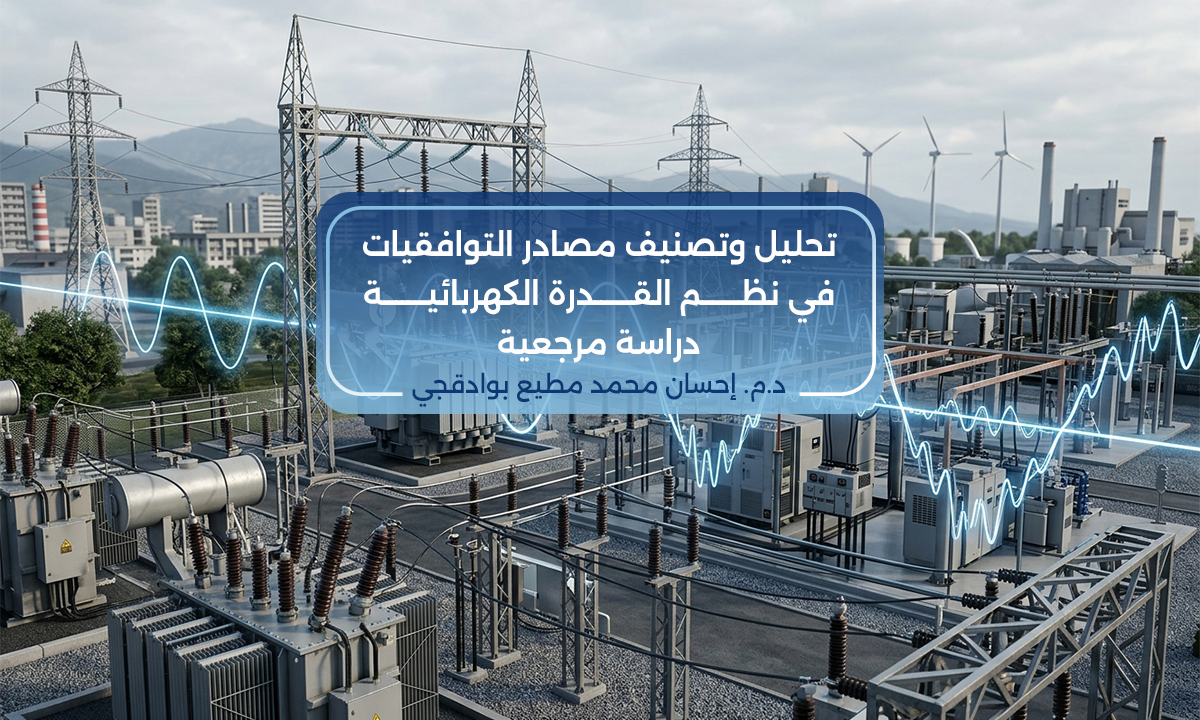
The primary cause of harmonic problems in electrical power systems is the massive increase in non-linear loads resulting from technological advancement, such as the use of power electronic circuits and equipment, particularly in AC-to-DC conversion and interfacing stages, or in loads powered by energy systems and utilizing electronic components or microprocessor-supported controllers. These devices generate harmonics due to the loads passing through power systems.
Before the advent of power semiconductors, the main sources of waveform distortion were the presence of electric arc furnaces, the cumulative effect of fluorescent lamps, and the limited deployment of transformers and electrical machines.
In general, harmonics are emitted by the following equipment:
* Converters
* Devices which include semi-conductor elements
* Generators
* Motors
* Transformers
* Lighting equipment working by gas discharge principle
* Photovoltaic systems
* Computers
* Electronic ballasts
* Uninterruptible power supplies (UPS)
* Switching power supplies
* Welding machines
* Control circuits
* Frequency converters
* Static VAR compensators
* Dynamic VAR compensators
* Arc furnaces
* HVDC transmission systems
* Electrical communication systems
 Review Articles
Dr. Eng. Jihad Saba
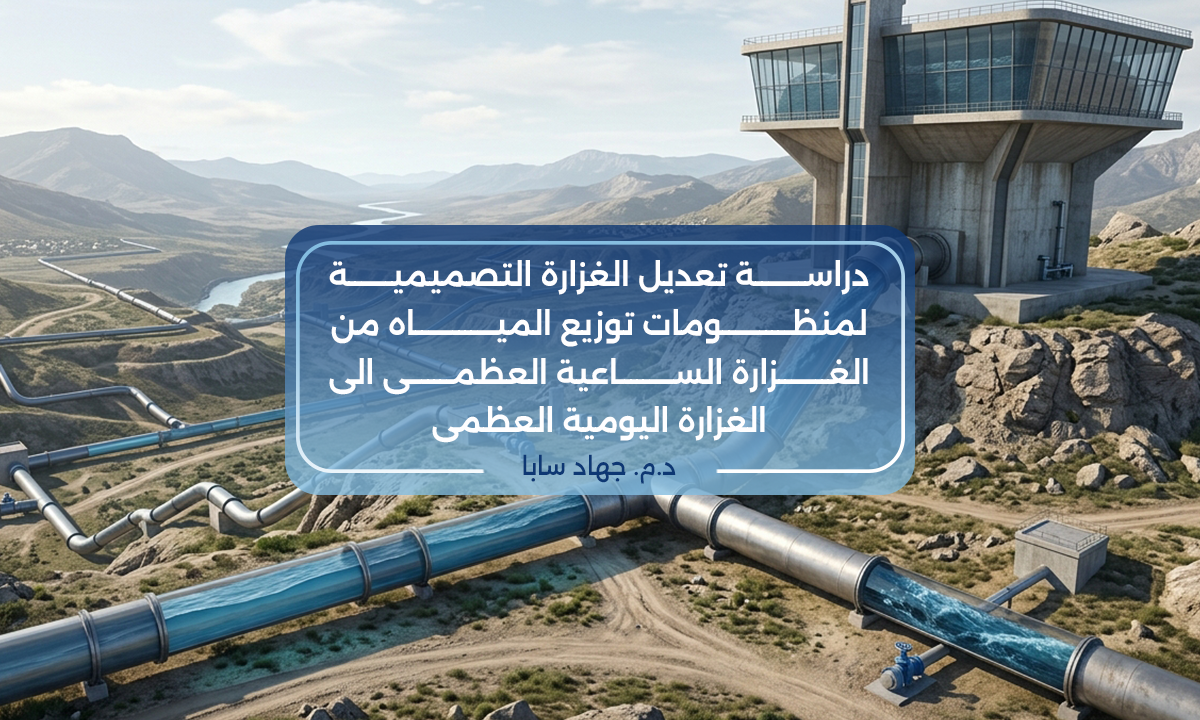
The design and analysis of drinking water distribution systems rely on several design parameters, including design discharge, which codes and references adopt as the maximum hourly discharge in the target year. However, following the performance of many drinking water distribution systems in Syria—especially daily and hourly discharges and consumption patterns—it has become evident that there is no single maximum consumption hour. Instead, peak consumption extends over a period of several hours with values lower than the maximum hourly consumption in the target year upon which systems are designed. That is, consumption values, patterns, and charts change as dictated by water scarcity conditions.
Technically and economically, network design heavily relies on the designer's experience in making an accurate and realistic selection of the design discharge for the entire system, as well as accurately predicting loads or withdrawals at system nodes. To achieve an acceptable estimation of design discharge and withdrawal quantities, studies on continuous water distribution systems have relied on the geometric method for population forecasting, rather than adopting a method suitable for the reality and nature of population growth in the study area. Under water scarcity conditions, studies on intermittent water distribution systems rely on field measurements and computer models that differ from continuous flow models due to the multiplicity and overlap of influencing factors.
Selecting the design discharge under water scarcity conditions fundamentally depends on the designer's experience, particularly under intermittent supply conditions. Therefore, work is underway to develop mathematical tools and simulation models to estimate future withdrawals, helping designers accurately predict water needs and design discharge. These models are built—after identifying the influencing factors and determining the contribution of each factor—using various techniques, including Regression and Artificial Intelligence (AI).
Determining node withdrawals under intermittent supply conditions—which is prevalent in Syria—with varying pressure conditions and the presence of building tanks and pumps, holds special importance in the study of drinking water systems under intermittent supply. The research concluded that for a better technical and economic design, it is preferable to select either the maximum daily discharge or the average daily discharge during peak summer months as the design discharge. It is also preferable to design drinking water networks in phases, with necessary calibration, making the design realistic and technically and economically viable.
 Review Articles
Ismail Al-Abed
The process of planning the infrastructure necessary for drinking water distribution in mountainous villages is one of the complex challenges facing decision-makers. This problem is evident in Syria in general and Latakia Governorate in particular, manifested by the spread of 'thirsty mountainous villages' that lack drinking water services. Since numerous criteria contribute to drinking water planning, alongside a clear divergence in the opinions of service-providing experts in this field, this research aims to develop a spatial digital model for drinking water distribution in mountainous villages. This model integrates the Partitioning Around Medoids (PAM) method with GIS functions to generate several analytical maps reflecting the proposed criteria in the target area.
The study resulted in the production of a combined surface map of potential intervention areas, which helps identify priority areas for intervention to provide drinking water networks in the studied region. This makes adopting such a model an essential phase when planning the necessary infrastructure for drinking water distribution in accordance with true stakeholders.
 Review Articles
Eng. Ola Adel Saleh
Syrian educational environments face several challenges in keeping pace with digital transformation and employing artificial intelligence to serve school curricula. These technologies can be significantly leveraged to empower students in general—and those returning from Western countries in particular—helping them understand Syrian curricula and easily integrate into the national educational system.
This study aims to design and implement a Retrieval-Augmented Generation (RAG) system based on pre-analysis to improve interaction with Syrian curricula by developing a smart educational platform trained on textbook content and enabling multi-lingual interaction with it.
The system relies on converting educational texts into numerical representations stored in semantic indices, allowing the retrieval of passages relevant to the query and generating appropriate answers in Arabic. Experiments showed a significant decrease in response time and memory consumption, along with good accuracy in answers, making this model a practical step toward effectively and feasibly integrating artificial intelligence into Syrian education.